According to architect Richard Witt, a principal at Quadrangle and designer of one of Toronto’s first tall-timber projects, the city has more such projects in the approvals pipeline than any other place in North America. The problem, however, is material supply, which is more than a little ironic in a country with as much wood as Canada. There are only a few manufacturing facilities for tall-timber components –cross-laminated beams, for example – and they can’t produce nearly enough supply to sate all that demand. “There’s a lot of chatter” about investment in large-scale engineered-wood plants, he says, but so far nothing more.
Witt argues that Ottawa and the provinces should create economic development incentives for investors to build such facilities. The government, he notes, invests in other industries (automobiles, fossil fuels), so why not tall timber? To contain the risk to investors, the federal government could kick in R&D grants, while municipalities could tweak building-permit fees and development charges to favour projects that use engineered wood components. Municipal planners could also fast-track tall-timber building projects, which can be constructed more rapidly than conventional structures, as a means of priming the pump.
Brewery Blocks: Mass Timber to Give a Boost to Tacoma’s Historic District
Mass timber could give a boost to Tacoma’s heritage district, up to 14 stories in fact, as part of a proposed $60 million multi-phased project that offers pedestrian-friendly, urban living complete with a mix of historic-style apartments, lofts, retail, restaurants and offices.

The first phase is already under construction, adding four new stories atop a former warehouse—soon to be home to 49 new apartments and over 10,000 square feet of commercial space—going up at a rapid rate of one floor about every eight days, thanks to the speed and agility of building with cross-laminated timber (CLT).
“This hasn’t been done in the state of Washington, this type of construction or the height,” says Troy Spurlock, Vice President of Construction of Horizon Partners, the firm spearheading the development. “It’s taken us three days to erect a floor of panels, versus two full weeks and probably a 20 man crew,” he explains in an interview with the Tacoma News Tribune.
Dubbed Brewery Blocks, the project is set to transform six buildings across two city blocks, further contributing to the downtown revival of this mid-sized port city southwest of Seattle. The project will provide more than 200 units of market-rate housing, 75,000 square feet of Class A office space, and 42,000 square feet of retail and restaurants.

CLT construction serves double duty, bearing the load while offering the warm welcoming aesthetic of exposed wood.

Future phases of Brewery Blocks proposes commercial space with exposed mass timber interiors.
CLT, combined with a steel frame, was chosen for the distinct benefits and advantages it offers over concrete when looking to retrofit century-old structures. Because CLT is relatively light while maintaining load-bearing strength, it can be a good option for developers looking to boost density to existing historic buildings, which would be impossible with heavier materials, or require more expensive reinforcement. CLT’s wood grain can be left exposed, complementing and blending well with historic timber and masonry buildings, like Brewery Blocks. As a naturally renewable building material, when combined with adaptive re-use of existing structures, CLT can not only boost the height, but also the environmental sustainability of buildings.
The robust engineered timber product, sometimes referred to as a super plywood of cross stacked boards glued and pressed together, will be used in multiple buildings throughout the development, including a 14-story high-rise. The two-story restaurant on the corner of Commerce and 21st, the seven-story office building and the four-floor extension of Brewery Lofts residential units will all make some use of CLT.
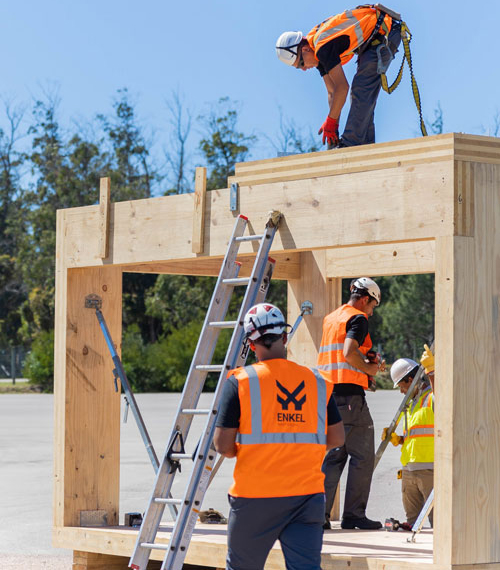
Enkel Group wants to give mass timber a boost in Uruguay and South America through intelligent construction methodology that has a positive environmental impact. This can be achieved through the use of counter-laminated wood panels as a raw material in construction projects achieving a cleaner, systematized and industrial architecture, betting on reducing execution times and costs, and improving the quality of the deliverables.
Source: Corporate Knights & Think Wood